
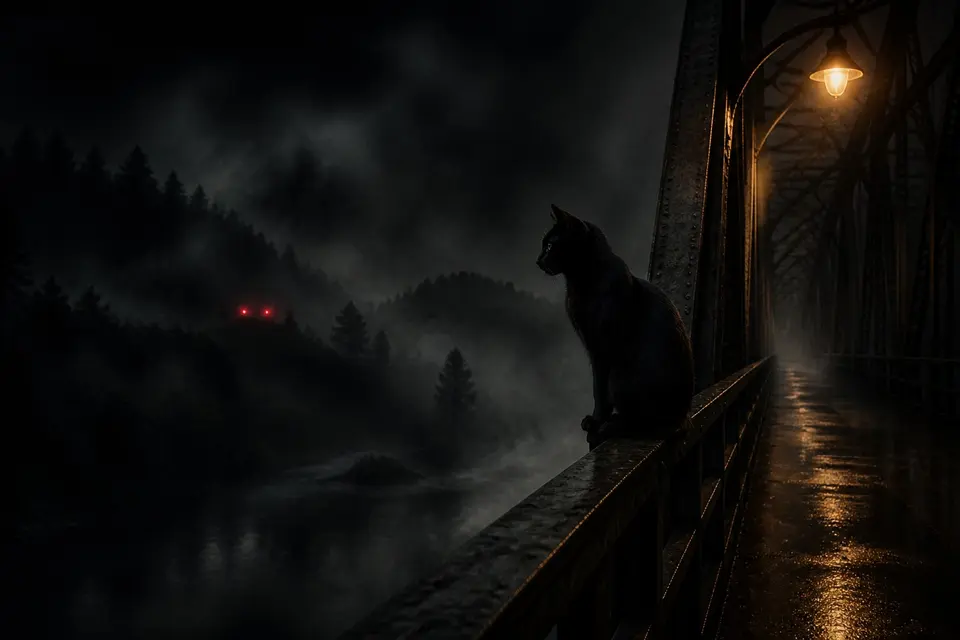
On the night of November 15, 1966, two young couples drove through an abandoned munitions site outside Point Pleasant, West Virginia, and saw something tall and winged standing near a building. They reported glowing red eyes and a wingspan that one account puts at ten feet. They drove to the courthouse and told a deputy sheriff. The next day a local paper ran the story under a headline about a man-sized bird. The creature that followed would be called the Mothman.
The question people ask is why it was seen in that town, at that time. The honest answer has three parts: what the witnesses reported, what ordinary explanations fit, and why a bridge disaster changed the story afterward.
What was reported
The usual telling begins with the Scarberrys and the Mallettes. Roger and Linda Scarberry and Steve and Mary Mallette told Deputy Sheriff Millard Halstead that they had seen a large winged figure near the area locals called the TNT area, the grounds of the former West Virginia Ordnance Works munitions plant. The Point Pleasant Register carried the first press coverage on November 16, 1966.
Some accounts place an earlier sighting three days before, at a cemetery in Clendenin, West Virginia, where men digging a grave said a human-like figure flew out of the trees. Sources disagree on how many men were there, and Clendenin is about 70 miles from the TNT area, which is why many tellers do not count it as part of the same story. For about a year starting in November 1966, over a hundred people reported seeing the Mothman, mostly in and around the TNT area.
Why there? A place that invites strange stories
The TNT area explains part of the answer. It was a former munitions plant, a large industrial site no longer in use, the kind of place where a startled driver might see something and tell friends. Once a story with a name was in the papers, more people were primed to notice and report one.
That does not mean the witnesses were lying. It means a sighting, a newspaper and a nickname build on each other. The same pattern shows up in many cryptid stories.
What could have been seen
Skeptics have offered ordinary candidates:
- A sandhill crane. A scientist at West Virginia University told reporters that the descriptions fit a sandhill crane, a very large bird with a wingspan of about seven feet and reddish skin around its eyes.
- An owl. Another common view is that the creature was a misidentified barn owl. In 1966, a snowy owl was shot at Point Pleasant, and local papers described it as a giant owl.
Neither explanation covers every report, and none can be proved after so long. Both fit the basic features reported: a large bird, a dark shape, eyes that caught the light.
The bridge
The story changed on December 15, 1967. The Silver Bridge, which connected Point Pleasant to Ohio, collapsed, and 46 people died. The sightings are generally dated to end at that point.
The link between the two came later. John Keel tied the Mothman to the disaster in his 1975 book The Mothman Prophecies, and one source credits an earlier link made by the writer Gray Barker in 1970. The result is that many people now remember the Mothman as a warning of the collapse.
The collapse itself has a documented cause. Investigators placed the failure in a single eyebar of the bridge chain, where a tiny crack, only a few millimeters deep, had grown over the years through corrosion and stress. Reports of the NTSB findings say the flaw could not have been found with the inspection methods of the time without taking the whole joint apart. Accounts also differ on details, such as how many vehicles fell into the river and when the final report was issued.
What is real and what was added later
Putting the pieces together:
- Real, and well documented: that people reported a large winged figure, that the Register covered it, that sightings were common over about a year, and that the bridge collapsed with 46 deaths.
- Contested or added later: that the creature predicted or caused the collapse. That link was made after the fact, in books. Other claims, such as a curse tied to a Shawnee chief named Cornstalk or low-frequency vibrations from the bridge causing hallucinations, are retellings and speculation that have not been substantiated.
So why was the Mothman seen in Point Pleasant?
The most defensible answer is a combination: a real place with a spooky reputation, a handful of striking reports that got fast press attention, ordinary large birds that look strange at night, and a tragedy that gave the whole story a meaning it did not have at first. None of that proves there was no creature, and none of it proves there was. It shows how a legend is built, one detail at a time.
Sources
- Mothman, e-WV: The West Virginia Encyclopedia
- The Mothman of West Virginia, Legends of America
- Mothman, Wikipedia
- Did the legendary Mothman first appear at Clendenin cemetery?, WV Explorer
- Silver Bridge failure 1967, STRUCTURE magazine
- The Silver Bridge collapses, killing 46, West Virginia Public Broadcasting
- Earlier disaster led to focus on bridge safety, NPR