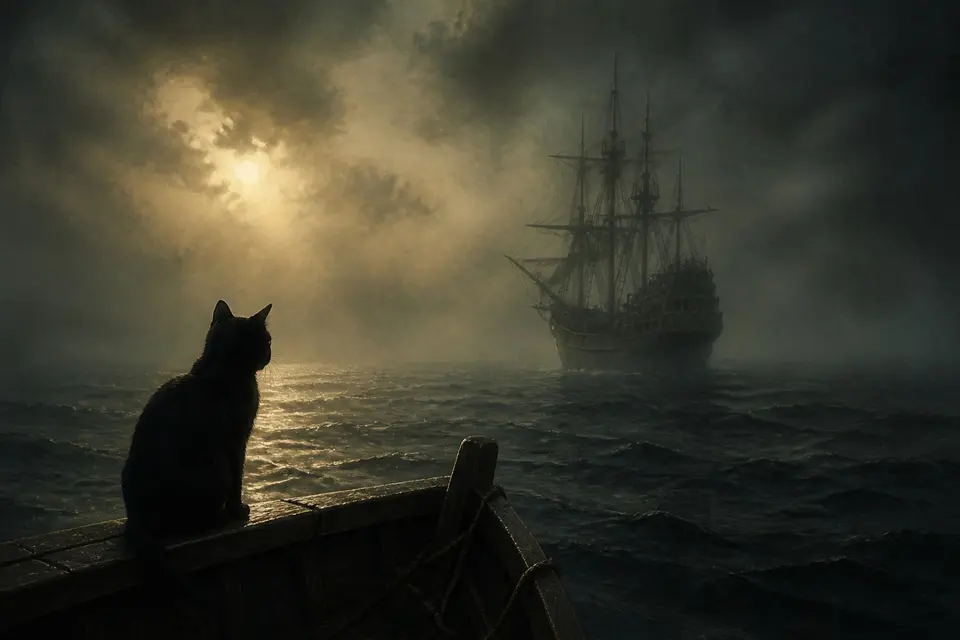
The Bermuda Triangle, also called the Devil's Triangle, is an area of the western Atlantic Ocean, usually drawn between Miami, Bermuda and Puerto Rico. According to legend, ships and planes vanish there without trace for mysterious reasons. When investigators looked into the cases one by one, however, a different picture appeared.
How did the legend begin?
The idea was born in the twentieth century. In 1964 the writer Vincent Gaddis published an article in Argosy magazine called "The Deadly Bermuda Triangle," which grouped several disappearances. The name caught on. Charles Berlitz's 1974 book The Bermuda Triangle became a bestseller and presented many cases as unexplained, offering theories from alien abduction to lost Atlantis. Television programs and films followed.
What are the most famous cases?
- USS Cyclops (1918). A US Navy cargo ship with more than 300 people on board vanished after leaving Barbados in March 1918. It was overloaded, had an engine problem and may have been caught in a storm or been structurally weak. The Navy never found it.
- Flight 19 (1945). Five Navy torpedo bombers on a training flight off Florida got lost and never returned, and a rescue plane also disappeared. The flight leader was reported to be disoriented about his position. The weather was worsening, and the planes probably ran out of fuel and crashed in rough seas. The rescue aircraft, a type nicknamed a "flying gas tank," is believed to have exploded.
- Other ships and planes. Cases from the 1940s to the 1970s are often listed, though some are not in the area, some happened in storms and some are poorly documented.
What did the researchers find?
In 1975, a librarian and pilot named Lawrence Kusche published The Bermuda Triangle Mystery: Solved, in which he checked the stories against newspapers, official records and weather reports. He found many errors and omissions in the earlier books: some ships were said to have vanished on calm days when there had been storms, some had sunk elsewhere, and some had never been in the area at all. A few of the cases, he found, had no documentary basis at all.
Is the area more dangerous than other seas?
Not according to the available data. The insurer Lloyd's of London has said that it does not charge higher rates for this area, and the US Coast Guard has said that it sees no evidence that disappearances are more common here than elsewhere with similar traffic. The region is one of the busiest in the world for shipping and flights, and it has sudden storms, strong currents like the Gulf Stream and shallow reefs. With so much traffic, accidents are expected.
What natural explanations are offered?
- Weather. The area has strong storms, waterspouts and hurricanes that can arise quickly.
- The Gulf Stream. A fast current can carry wreckage away and scatter evidence.
- Human error. Navigation mistakes, mechanical failures and overloaded craft explain many cases.
- Deep water. The Puerto Rico Trench is among the deepest parts of the Atlantic, so wreckage is difficult to find.
A theory that bursts of methane gas from the seafloor could sink ships has been discussed, but there is no evidence it has caused an accident in the area, and most scientists regard it as unlikely.
Why does the legend continue?
Stories of disappearance appeal to our curiosity, and the idea of an invisible hazard is more dramatic than a list of routine accidents. A repeated claim can also seem true. Studies of how legends develop show the same pattern in the Roswell incident and in the sea-monster claims of Loch Ness.
How should you think about it?
When you meet a mysterious disappearance, ask: Where and when exactly did it happen? What was the weather? Who recorded it, and when? Are there records that confirm the account? These questions turn a puzzle into an investigation. For a story of a ship with a different kind of reputation, see the Queen Mary.
What about the strange compass stories?
Some books claim that compasses spin wildly in the area. A real effect is that a magnetic compass points to magnetic north, not true north, and in the Bermuda Triangle region the difference between the two is small, which is actually a reason some old navigators praised it. Compasses do deviate near metal or electrical equipment on a ship or plane, and in storms, but there is no evidence of a special force in this area. Modern ships and planes use satellite navigation, and routine crossings through the region are made every day without incident.