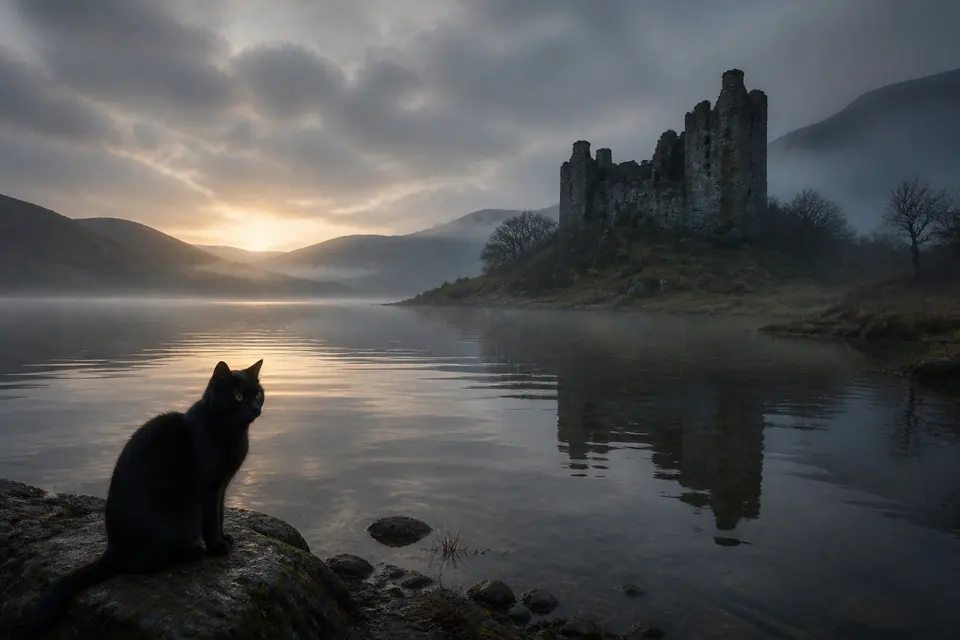
The Loch Ness Monster, nicknamed Nessie, is said to live in a long, deep lake in the Scottish Highlands. Sightings and photographs have appeared for almost a century, and the lake has been searched with sonar, submarines and even DNA tests. Looking at each kind of evidence shows why the monster remains a legend and what real science has found.
Where does the story begin?
An old text, the Life of Saint Columba, written about 700 CE, tells of the saint calming a beast in the River Ness in the sixth century. Scholars note that the text describes a river and a miracle story, not a lake monster of the modern type. The modern legend began in 1933, when a new road along the loch opened the shore to travelers and a local couple reported seeing a large creature in the water. Newspapers took up the story and the name "monster" spread worldwide.
What are the famous photographs?
The best-known image is the "Surgeon's Photograph" of 1934, which shows what looks like a long neck and head rising from the water. It was published as the work of a respected London surgeon, Robert Kenneth Wilson. In 1994, the story was exposed: a participant, Christian Spurling, said that the picture showed a toy submarine with a head and neck made of plastic wood, part of a hoax organized by a film maker, Marmaduke Wetherell, who wanted revenge after a newspaper had mocked him for finding fake footprints. Other pictures and films have been shown to be waves, boat wakes, floating logs, swimming animals or deliberate fakes.
What about sonar and searches?
Several large searches have taken place. In 1987 Operation Deepscan used a line of boats with sonar to sweep the loch and recorded some unexplained contacts, which were never confirmed as a large animal. Other expeditions with underwater vehicles have not produced a body, bones or clear images of a large animal. The loch is deep, about 230 meters at its deepest, and its water is murky with peat, which makes sight hard, but a breeding population of large animals would be expected to leave more traces.
What did the DNA study show?
In 2018 a team led by the geneticist Neil Gemmell collected water samples from many parts of the loch and analyzed the environmental DNA, the traces of genetic material that living things leave in water. They identified tens of thousands of species of organisms, but found no sign of reptile DNA, such as that of a plesiosaur, the prehistoric marine reptile that is often suggested. They did find a large amount of eel DNA, and they said that the possibility of unusually large eels could not be excluded, although it is not proof.
What are the scientific objections?
- Food. A population of large predators needs a lot of food, and the loch has limited fish.
- Breeding. A single animal could not live for centuries, so there would have to be a population, which would be seen more often.
- Biology. A plesiosaur would need to breathe air, so it would surface regularly, and its body would not suit cold water.
- No remains. No bones or carcasses have been found.
What might people be seeing?
Likely explanations include waves and wakes, floating logs, birds and otters, large fish or eels and optical illusions on a still surface. Seiches, which are waves that rock back and forth in a lake after wind or pressure changes, can also create strange moving humps.
Why does Nessie endure?
The legend offers wonder, a beautiful place and a sense that nature might still hold surprises. It brings tourism to the Highlands, and a successful monster industry has grown up around it. Psychologists also note that expectation affects perception: when people are told what to look for, they interpret ambiguous shapes accordingly. Other cases of creatures supported by sightings and not by bodies are the Jersey Devil and the Mothman.
What is the fair verdict?
There is no reliable evidence for a large unknown animal in Loch Ness, and the best-known photographs are fakes or misidentifications. That does not make the search foolish: it has taught us about the loch, and a mystery that is not solved can still be a good reason to learn how to examine evidence. A similar case in the sea is explained in the Bermuda Triangle.